Table of Contents
EV Charger Repair Hyderabad: On-Site Diagnostics, Hardware Fixes & SLA Maintenance
As electric vehicles become standard across Telangana, maintaining functional, reliable charging hardware is critical for both residential owners and commercial network operators. When an electric vehicle charger fails, immediate professional EV charger repair in Hyderabad prevents extended vehicle downtime and avoids costly revenue losses for commercial hubs.
From residential wallboxes in Gachibowli apartment complexes to commercial DC fast-charging hubs along the Outer Ring Road (ORR), EV charging equipment in Greater Hyderabad faces unique environmental challenges. High summer ambient temperatures, monsoon moisture ingress, severe dust accumulation, and grid voltage fluctuations routinely cause hardware trippings and internal electronic faults.
This guide details common charger failure symptoms, diagnostic protocols, component-level repair workflows, local service rates, and doorstep repair coverage across Greater Hyderabad.
1. Primary Reasons for EV Charger Failures in Hyderabad
EV charging hardware contains delicate microelectronics, high-voltage contactors, and complex communication controllers. Local environmental conditions in Hyderabad directly contribute to specific hardware failure patterns:
                  [ LOCAL ENVIRONMENTAL IMPACT ON EV CHARGERS ]
                                        │
      ┌─────────────────────────────────┼─────────────────────────────────┐
      ▼                                 ▼                                 ▼
[ Extreme Summer Heat ]       [ Monsoon Moisture ]            [ Local Grid Spikes ]
• Power module throttling     • Earth leakage tripping        • PCB capacitor blowout
• Thermal sensor cutoff       • Connector pin oxidation       • Contactor coil burnouts
• Display screen blackouts    • Short circuit faults          • Surge arrester tripping
- Grid Voltage Instability: Frequent neutral shifts and grid voltage surges across rapidly expanding industrial and suburban corridors (such as Kukatpally, LB Nagar, and Kompally) often blow out surge protection devices (SPDs) and internal power supply units (PSUs).
- High Ambient Operating Temperatures: Summer temperatures exceeding 42°C cause thermal throttling in DC rectifiers and wallbox power boards, triggering emergency thermal cutoffs mid-charge.
- Monsoon Moisture Ingress: High humidity during monsoon downpours leads to earth leakage resistance drop (< 1 MΩ), resulting in immediate RCCB/ELCB breaker tripping upon plugging in.
- Dust & Silica Accumulation: Deccan fine dust settles inside cooling vents, clogging cooling fans and causing contact pin pitting on CCS2 and Type-2 charging guns.
2. Diagnostics & Common Failure Symptoms
Recognizing the exact fault code or physical symptom helps field engineers perform rapid target repairs.
| Error Symptom / Code | Root Technical Cause | Typical Affected Components | Recommended Technical Fix |
| Red Light Flashing / Error State | Failed CP/PP signal handshake or CAN bus error | Control board, CP/PP resistors, lock motor | PCB firmware flash or signal board replacement |
| Instant RCCB / Breaker Tripping | Moisture ingress or insulation breakdown | Earthing pit, surge arrester, main contactor | Insulation resistance testing, re-earthing |
| Charging Throttles (e.g., 60kW to 15kW) | Overheating of rectifier or blocked air filters | Power modules, cooling fan blower, heat sink | Fan replacement, thermal paste re-application |
| Gun Locked / Refuses to Disengage | Solenoid pin lock jammed or 12V supply failure | Electromechanical gun lock, 12V relay | Manual override pull-release, lock motor swap |
| No Display / Offline Telemetry | 4G/5G module fault or power supply IC blow | Modems, auxiliary PSU, LCD controller | Modbus gateway swap, auxiliary PSU repair |
3. On-Site Field Repair vs. Lab Component Repair
Specialized EV charger servicing in Hyderabad is divided between fast, doorstep field repairs and deep laboratory PCB rework.
                           ┌─────────────────────────┐
                           │   Fault Triage Process  │
                           └────────────┬────────────┘
                                        │
           ┌────────────────────────────┴────────────────────────────┐
           ▼                                                         ▼
[ On-Site Doorstep Service ]                              [ Bench Repair Laboratory ]
• Cable & Gun replacement                                 • Micro-soldering PCB components
• Contactor & relay swaps                                 • DC Power Module / Rectifier rebuilds
• Earth resistance testing & pit fixes                    • Firmware recovery & chip flashing
• MCB, RCCB & SPD upgrades                                • Load-bank resistance validation
On-Site Doorstep Repairs
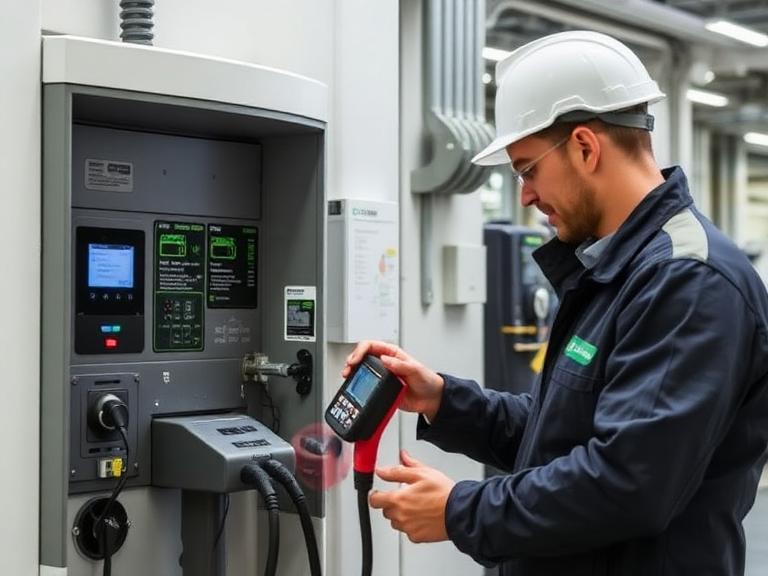
Mobile service vans equipped with diagnostic meters and spare parts handle immediate physical fixes across Hyderabad:
- Insulation Resistance (Megger) Testing: Testing up to 1,000V DC to detect cable jacket deterioration or ground faults.
- Connector Gun & Cable Replacement: Replacing worn-out CCS2, Type 2, or 15A cable assemblies on-site.
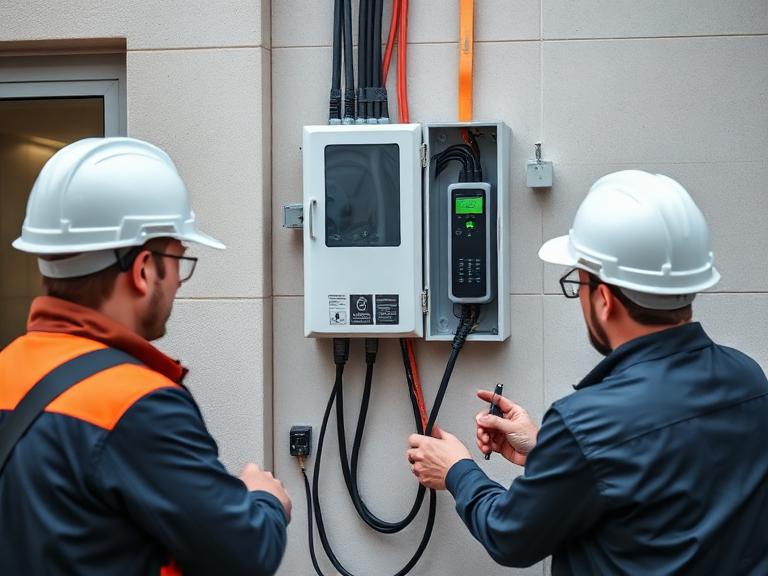
- Panel & Breaker Servicing: Upgrading faulty RCCB/MCB units, tightening loose terminal blocks, and restoring earthing pits.
Advanced Workshop & Laboratory Rework
For complex motherboard failures or burnt rectifier circuits, equipment is routed to specialized electronics workshops in Cherlapally, Uppal, or Balanagar:
- Micro-Soldering & PCB Rework: Replacing blown MOSFETs, IGBT switching modules, optocouplers, and diode bridges.
- DC Rectifier Module Rebuilding: Recalibrating high-power DC converter modules and replacing degraded electrolytic capacitors.
- Simulated Load-Bank Testing: Validating repaired chargers on multi-kW resistive load banks before returning them to service.
4. Preventive Maintenance & Servicing Workflow
Regular preventive servicing extends the lifespan of both residential wallboxes and commercial fast chargers.
[ Phase 1: Visual & Mechanical Inspection ]
  ├── Check connector pins for pitting, charring, or arc damage.
  ├── Test cable strain relief and mechanical holster retention.
  └── Clean air intake filters and heat-sink fan louvers.

[ Phase 2: Electrical Safety Audit ]
  ├── Measure earth resistance pit levels (must be < 2.0 Ohms).
  ├── Perform Megger insulation tests across all line connections.
  └── Verify Emergency Stop (E-Stop) button isolation circuit.

[ Phase 3: Thermal & Load Calibration ]
  ├── Conduct FLIR thermal imaging under active full-load charging.
  ├── Check terminal lug torque levels to prevent hot-spots.
  └── Verify line voltage stability under full vehicle load.
5. Local Service Charges & Rate Card in Hyderabad
Service costs in Greater Hyderabad depend on whether the repair involves basic wiring fixes, component swaps, or deep board rework.
Average EV Charger Service Rate Card (Hyderabad):
- On-Site Inspection / Diagnostic Visit Fee: ₹500 – ₹1,000 (Waived if repair work is awarded)
- AC Charger Basic Wiring / Contactor / Earthing Fix: ₹1,500 – ₹3,500
- AC Home Wallbox Mainboard / PCB Repair: ₹2,500 – ₹5,500
- CCS2 Fast-Charging Gun & Cable Replacement: ₹18,000 – ₹32,000
- DC Power Module / Rectifier Repair (Per Module): ₹12,000 – ₹25,000
- Annual Maintenance Contract (AMC) – AC Home Wallbox: ₹3,000 – ₹5,000 / year
- Annual Maintenance Contract (AMC) – Commercial DC Station: ₹25,000 – ₹55,000 / year
(Note: Prices are exclusive of 18% GST and manufacturer replacement parts.)
6. Coverage Areas in Greater Hyderabad
Specialized EV charger repair technicians and mobile service teams cover all key commercial, residential, and industrial corridors across the HMDA region:
- West Hyderabad (Tech Corridor): HITEC City, Gachibowli, Kondapur, Madhapur, Financial District, Nanakramguda, Kokapet.
- North & Central Hyderabad: Kukatpally, Miyapur, Nizampet, Secunderabad, Begumpet, Banjara Hills, Jubilee Hills.
- East & South Hyderabad: Uppal, Ghatkesar, LB Nagar, Dilsukhnagar, Shamshabad, RGIA Airport Area.
7. Frequently Asked Questions (FAQs)
Why is my EV charger showing a red error light and refusing to start charging?
A red error light typically indicates a failure during the initial handshake protocol between the charger and the vehicle’s onboard battery management system (BMS). Common causes include corrupted CP/PP signal lines, unstable voltage input from the grid, an earthing failure, or an internal contactor trip.
How quickly can a field technician arrive for EV charger repair in Hyderabad?
For doorstep residential repairs in major zones like HITEC City, Gachibowli, and Kukatpally, field engineers typically arrive within 12 to 24 hours. For commercial fleets and public DC fast-charging hubs covered under an AMC, emergency response times range from 2 to 4 hours.
Can a damaged CCS2 charging cable or gun be repaired, or does it require full replacement?
Minor mechanical latch repairs or pin cleaning can be performed on-site. However, if the main copper conductors exhibit thermal pitting, insulation melting, or internal wire breakage, full cable and gun assembly replacement is mandatory for safety.
What causes the EV charging gun to get stuck in my car’s charging port?
Gun locking issues occur when the electronic locking solenoid inside the vehicle’s charging inlet or the charger’s gun locking pin fails to retract due to dust accumulation or a 12V signal failure. Most chargers and EVs feature a manual emergency release pull-cord inside the boot or behind the charging port.
Will getting my EV charger repaired by an independent service provider void its warranty?
If your charger is within its active OEM warranty period, repairs should be performed by authorized brand technicians. For out-of-warranty chargers, certified independent repair providers offer faster, cost-effective component-level fixes.